
A philosophy exposed
A worldview in which wealth becomes insulation, fame becomes camouflage, and influence becomes a shield against consequence.

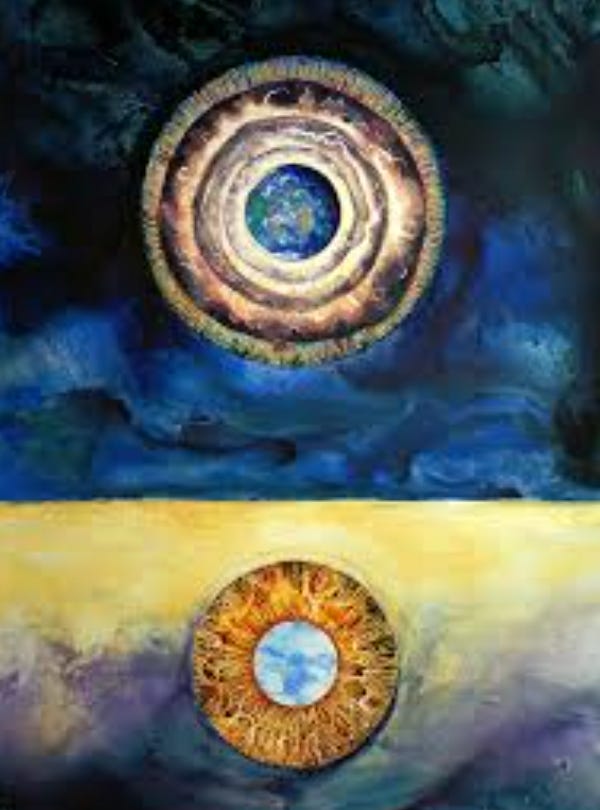
(Painting by Maya Margit)
In a week when the newly released Epstein files have once again pulled back the curtain on power—on private jets and private islands, on men who built empires and revealed the smallness of their souls—I find myself returning to the quiet voice of Henri Nouwen.
Nouwen wrote:
“There is much emphasis on notoriety and fame in our society… What counts is to be known, praised, and admired. Still, real greatness is often hidden, humble, simple, and unobtrusive… Some of the greatest works of art and the most important works of peace were created by people who had no need for the limelight. They knew that what they were doing was their call, and they did it with patience, perseverance, and love.”
His words land differently now.
Because what we are witnessing is not just criminality. It is a philosophy exposed. A worldview in which being known, praised, and admired matters more than being good, moral, ethical, humane. A worldview in which wealth becomes insulation, fame becomes camouflage, and influence becomes a shield against consequence.
The Epstein files do more than document alleged crimes. They reveal a spiritual failure at scale. They show what happens when notoriety replaces character as the measure of a man.
We live in a culture that confuses visibility with virtue. We amplify the loud. We reward the bold. We platform the outrageous. We tell ourselves that if someone is on television, on magazine covers, at galas and summits and ribbon cuttings, they must be worthy of our attention—perhaps even our reverence.
But Nouwen reminds us that real greatness is often hidden.
Hidden in the teacher who protects a child.
Hidden in the journalist who refuses a bribe.
Hidden in the assistant who says, “This isn’t right,” even when the boss is powerful.
Hidden in the survivor who speaks, knowing she will be attacked for it.
Hidden in the friend who believes her.
The tragedy of powerful, wealthy men showing their true, animal selves is not only that they harmed others. It is that they mistook appetite for entitlement. They confused access with worth. They believed that because they could, they should.
This is what happens when admiration becomes the drug.
Nouwen understood something we are still struggling to learn: we must have strong self-confidence combined with deep humility. Confidence without humility curdles into arrogance. Power without humility metastasizes into abuse. Wealth without humility becomes predation.
Humility does not mean self-erasure. It does not mean shrinking. It means understanding that your gifts are not proof of your superiority. They are responsibilities. They are entrusted to you for the sake of others.
Many of the men implicated in the Epstein orbit were celebrated as visionaries, philanthropists, dealmakers, thought leaders. They were invited to stages. Quoted in glossy profiles. Applauded for their brilliance.
And yet, brilliance without goodness is not greatness.
What Nouwen calls us back to is a different metric entirely.
Not: How many people know your name?
But: Who is safer because you are alive?
Not: How many rooms can you enter?
But: What do you do with the power you carry into those rooms?
The most important works of peace, he wrote, were created by people who had no need for the limelight. They did their work with patience, perseverance, and love.
Patience is not flashy. Perseverance does not trend. Love is rarely monetized.
And love is the opposite of exploitation.
In a culture mesmerized by the spectacle of powerful men falling, perhaps the deeper work is quieter: to withdraw our automatic admiration from fame itself. To stop assuming that wealth signals wisdom. To measure greatness by gentleness. To value obscurity over notoriety if obscurity is what integrity requires.
The Epstein files expose the grotesque theater of power without conscience. Nouwen offers us a different stage entirely—one where the work is hidden, humble, simple, unobtrusive.
The question is not whether powerful men will continue to reveal themselves. History suggests they will.
The question is whether we will keep mistaking visibility for virtue.
Real greatness is rarely loud. It does not need a jet, an island, a fortune, or a headline. It does not need to be seen to be real.
It only needs to be faithful to its call.
Love,
Patti
Every word.
As always - thank you, Patti!
I’ve always loved Henri Nouwen and his teachings and I love the juxtaposition you used to show power/corruption vs goodness/humility. Wonderful essay 💛