

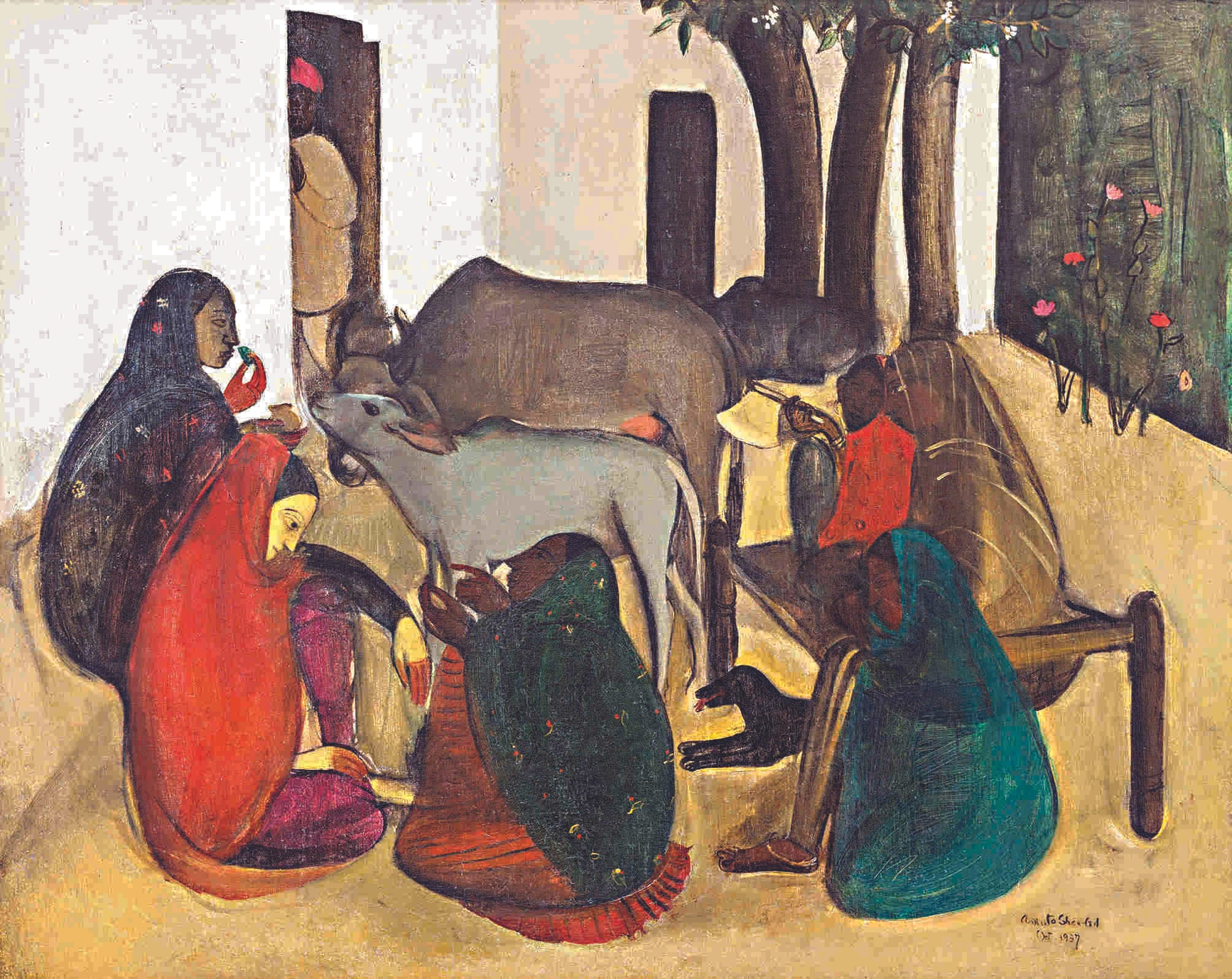
(“The Story Teller” by Amrita Sher-Gil, 1937)
The shortest distance between two people is a story.
I saw that fact unfold this past weekend again as a small circle of women gathered with me to write. Not to impress. Not to produce perfect pages. But to sit in the deep safety that forms when stories are shared. We explored having a place to stand, a home. We asked for play, fun, joy, community. We wanted to extend ourselves and to roll around with words.
We wrote about wings snapping open, pilgrimages to puffins, pianos with porcelain dogs on top, knitting with grandmothers, molting like cicadas, paintings we love, stitching, what dogs might experience while dying, fragile ornaments that are symbolic when they shatter, the smell of our skin after being in the sun, and 1,500-year-old knitted socks in a museum. Each story moved from us and landed inside someone else. We talked about the choices we make when we write.
Among other things, we experimented with ekphrastic poetry—capturing a spatial experience in a linear form. Something you see all at once becomes something the reader moves through word by word, through time. It reminds me why I studied Chinese: how image and meaning can coexist, braided together in a single character. Language does the same work—bridging perception and expression.
We played with others' language to create new images, sounds, and meanings in cento poems. We were not a gathering of poets, but we became poets for a few days because poetry can teach us things about economy, metaphor, image, movement, juxtaposition, contrast and congruence, and naming that prose cannot. Changing forms helps us see again.
So we played. With words. With ideas. With images and sense memories. We wrote about paintings and photographs, but also about the internal landscapes we carry. Spaces we inhabited decades ago. The smell of the earth after a rain. The exact color of the sky on the day something important happened. Writing became a form of noticing. And noticing is one of the great acts of being alive. As poet Mary Oliver wrote in her poem, “Sometimes,”
“Instructions for living a life:
Pay attention.
Be astonished.
Tell about it.”
In the evenings, we read aloud. Words that felt private on the page entered the room. Voices sometimes trembled. But something shifted when we heard our own sentences aloud and the sentences of others. The community responded—not with judgment, but with curiosity, reflection, and generosity, believing in the possibility of the work. We learned by being witnesses, by being attentive, by reading and listening like a writer. Feedback was an offering, not an instruction. Every writer ultimately decides for themselves what serves the work and what does not.
By the end of the weekend, the pages are fuller, but that’s not the real change. The stories are no longer held by one person. They’ve been heard, witnessed, and carried across hearts, becoming something deeper and wider. We arrived as individuals. We leave as a constellation of stories.
And at the end of our writing weekend, we declared it done.
The shortest distance between two people is still a story—and maybe, in some small way, you’ve just walked it with us. Tell someone your story today.
With love and appreciation for the writers who joined me in this exploration,
Patti
You have captured one of the marvelous ways of being in community. I used to participate, in the old days of Twitter, in Twitter Poetry parties. While there was a group of us that generally always showed up, people we didn't know also took part in writing responses to whatever prompt had been offered. Later, someone in our group put all the responses together in one or more poems. It was a lot of fun, and truly created a feeling of being in it for all the right reasons.
You mention some of the poetic forms I especially like: centos and ekphrastic poetry. I also love writing "found" poetry.
The next best thing to being there is reading this account. 🩷🩷🩷