
The Architecture of a Face
What bones did you come from?

He reminded me of an eagle. That is the truest thing I can say about my grandfather Lonnie Gold Digh, who was born in North Carolina in 1894 and died in 1971 when I was almost twelve, before I ever got to know him as a person rather than a presence. Impossibly tall, my shoulder reaching only his belt level, spare as a winter tree, with cheekbones so sharp and decisive they seemed to have been cut rather than grown. I loved him the way you love a landscape: completely, wordlessly, without being able to explain why. I was also sometimes nervous around him because he loomed so large, was so silent, and his eyes were so piercing. If I stood too close to him, I had to lean my head all the way back to see his face, and his neck had to bend in the opposite direction.
He was 65 years old when I was born; Grandma was 58, so I only ever knew them as ancient. Now that I’ve passed both of those ages, I beg to differ. But I have also experienced aging now, so I can identify with where they were in life during my time with them.
He had a grey-wooded work shed, built by him, one window over the workbench. I think it was his favorite place. I know it was open only by invitation. It had a cool atmosphere, like the sun didn’t reach it, even in summer. That one window overlooked the cemetery of Broughton Hospital, the state mental institution next door. I did not find this strange at the time. I find it beautiful now, that a man would build his workshop with a view of the dead, and that this is where he chose to teach his granddaughter the names of tools.
The shed smelled of the oil he used on his tools, a smell I have never been able to name exactly but would know anywhere, a smell that means him. He taught me to use his heavy, red, paint-chipped vise. A wooden hammer. A red-handled chisel that said “Fuller.” A monkey wrench. A scratch awl. An auger. His metal wheelbarrow with the worn wooden handles, smooth to the touch of my little hands. He made me a lamp out of wood that I still use.
Grandpa never questioned whether a girl should be in his toolshed, learning to make things. He never favored my brother or the boy cousins. Somehow, he knew I was capable, serious, teachable. That I paid attention. That I would remember those lessons my whole life. That I could, and preferred, to work in silence like him.
I would realize, as an adult returning to that land, that the cemetery he looked out over had only round metal tags hanging from chains, one per grave, over 1,500 of them. The tags had numbers on them, not names. Patient numbers. Whole lives erased. Humans reduced to bones and integers. (In more modern times, I hear this has been changed, and names instead of numbers now appear there.)
Grandpa had nicknames for all his grandchildren. My brother and I both had bright red hair, so we were Rusty and Penny. An overweight cousin was always Tater.
Grandpa did not say much, that I remember. He taught through doing, through the simple wordless act of standing beside you while you figured something out. Sometimes he would walk me over to the Broughton grounds to see the pigs, three of my steps to one of his. I loved the pigs. I think he knew that. We would pick muscadines as we walked back from there, rolling the thick skins of them around in our mouths after we popped them open, Grandpa picking the ones I could never have reached.
I always thought he was teasing when he told me his middle name was “Gold.” I only found out when he died that he had been telling the truth. The obituary and headstone said so. I found this out secretly, never telling anyone I had doubted it.
He had a big garden, too. It filled the space between his house and Mull Brother’s grocery with the sawdust on the floor behind the meat counter. As I got older, he would give me a quarter and let me run down the dirt path beside the garden to Mull’s for an orange sherbet push-up in a cardboard tube like a toilet paper roll, decorated with wide blue, red, and yellow circles, and with a little frilly white cap over the top of it. I was both proud and nervous doing that.
Sometimes, I would help him dig up spring onions, thin and sharp-smelling, and we would wash them at the outdoor spigot, cold water over our hands, and eat them standing right there in the dirt. No salt. Just the onion and the cold and the sun.
He was one of fourteen children born to John Pinkney Digh and Margaret Alice Carter, who farmed the North Carolina Piedmont in the last decades of the nineteenth century. Lonnie was born in 1894, in the middle of the pack. He grew up tall and angular in a family of angular people, carrying in his face whatever the Dighs and the Carters had been carrying for generations before him.
I know this now because I have the photographs.
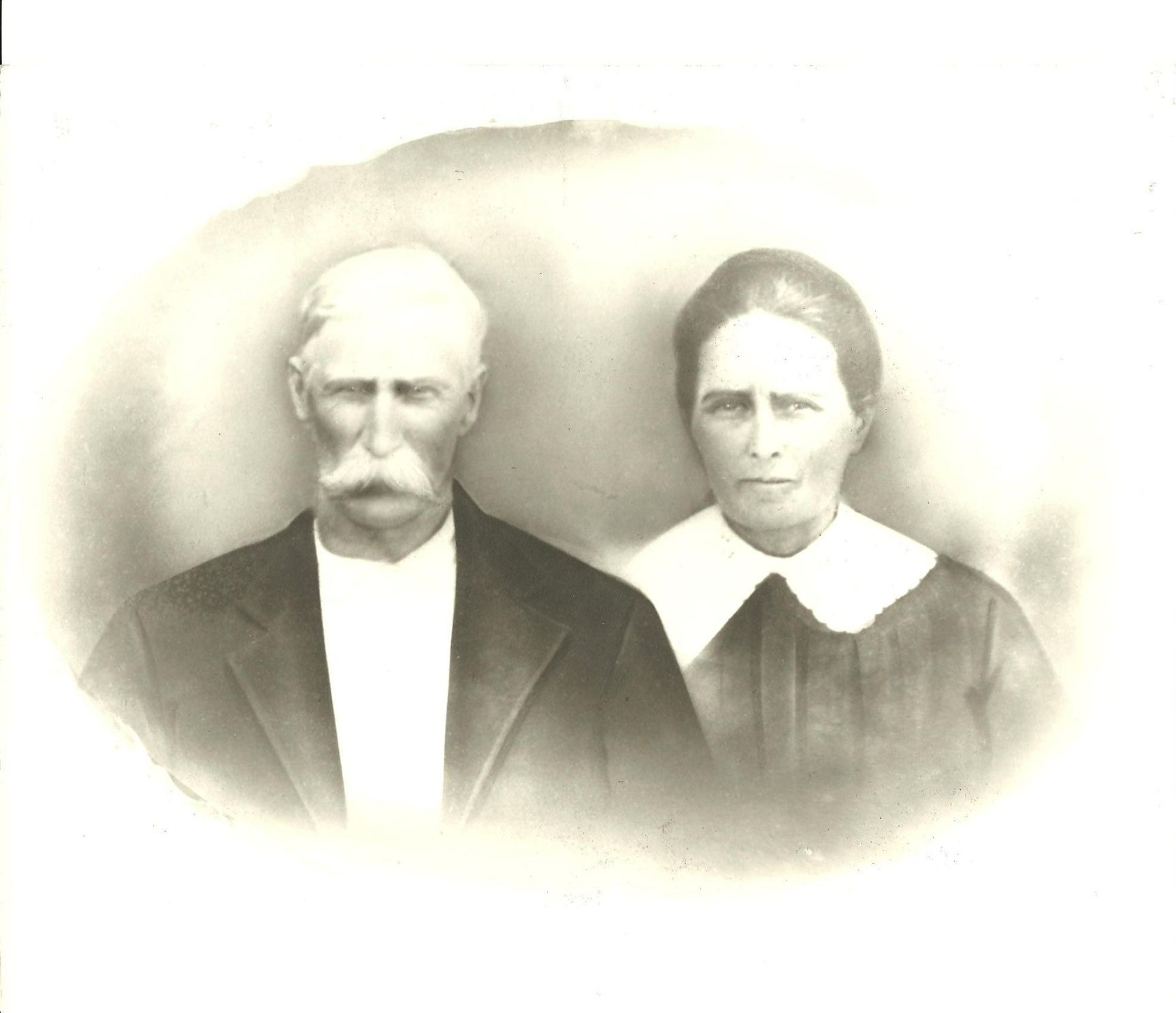
There is a formal portrait of John Pinkney and Margaret Alice—the kind of portrait that required stillness and intention, that people dressed for, that took something out of them to sit for. John Pinkney has a full white mustache and a strong jaw, and he looks like a man who has worked very hard for a very long time. But it is Margaret Alice who stops me. Her cheekbones are extraordinary. High and sharp and utterly certain of themselves, as if the bone itself had something to say and said it plainly. She has grandpa’s thin, straight mouth, or vice versa, I guess. She looks directly into the camera with an expression that is not quite stern and not quite sad and entirely her own. She is the origin of something. You can see it.
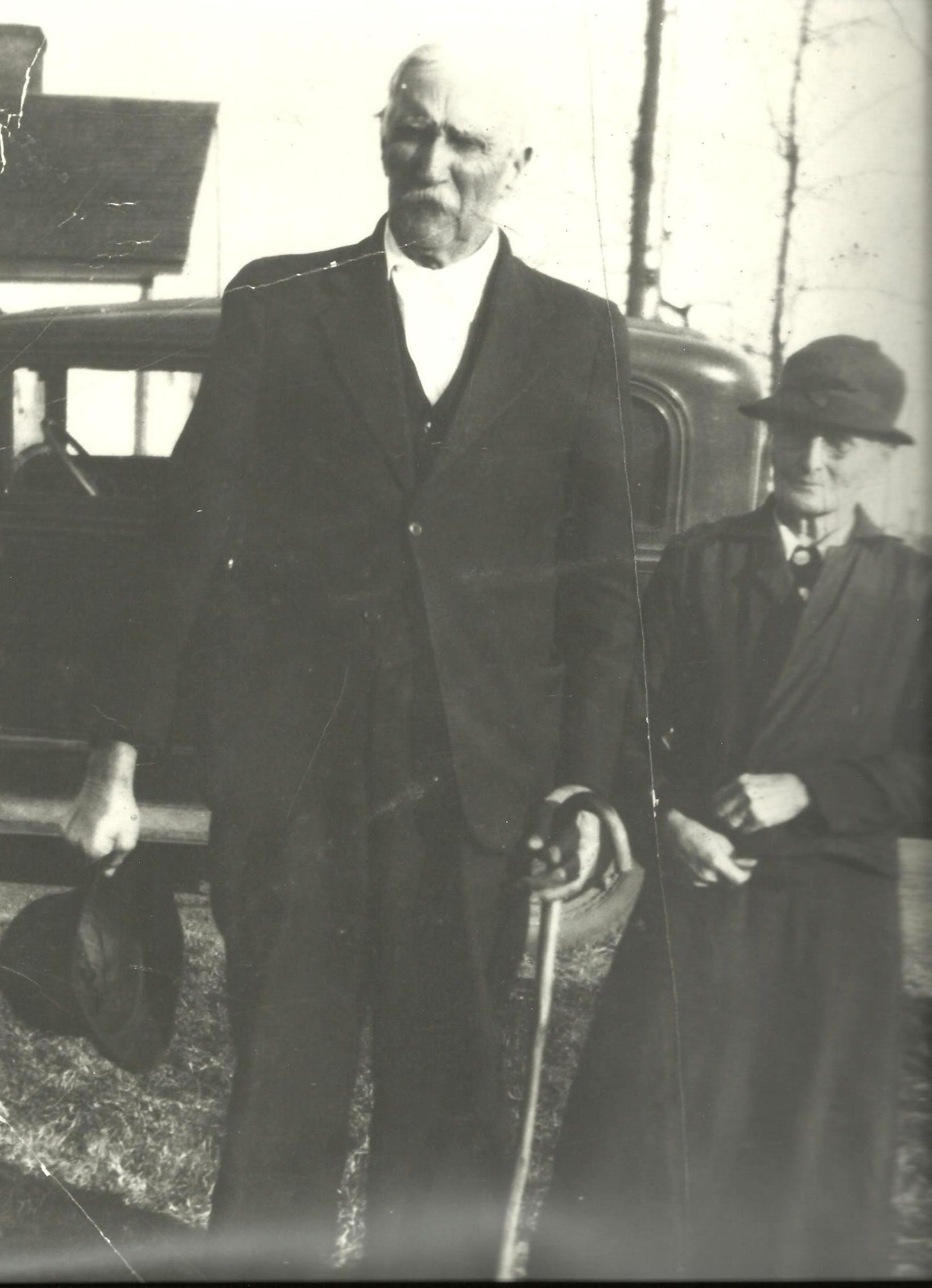
She is also so tiny beside his towering figure. And so tiny to have had 14 children.
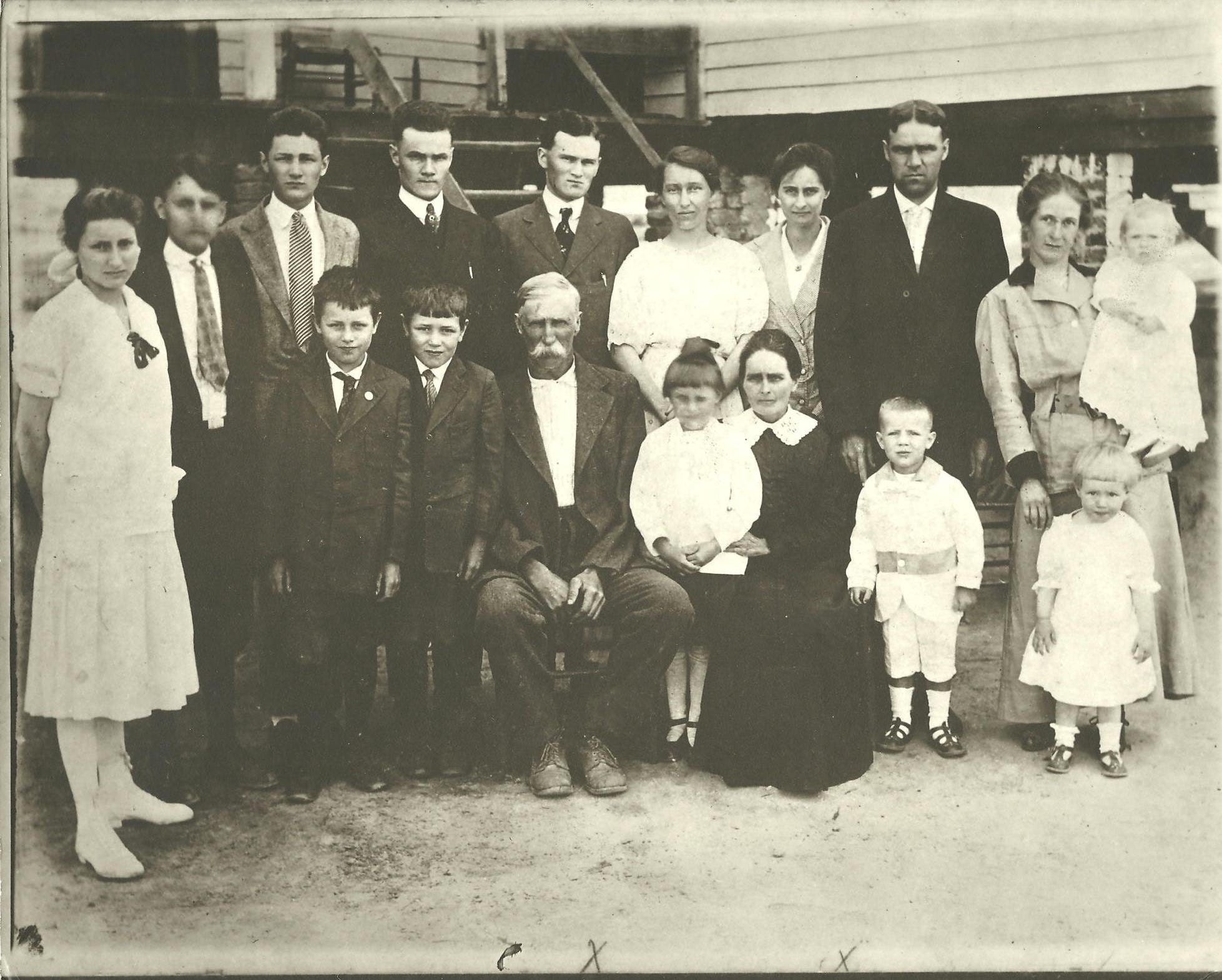
Then there is the family photograph, taken sometime in the early years of the last century, all of them gathered in front of what must have been the home place: John Pinkney and Margaret Alice seated at center, their children arranged around them in the way families arranged themselves then, formally, for the record.
And there in the back row, standing among his brothers, is Lonnie. Young, maybe twenty, already carrying the height and the stillness I would know decades later. Already wearing that face. The bones already doing what they would go on doing, announcing something, declaring some lineage that had come down through Margaret Alice and further back still, through whatever Scots-Irish and English and Nordic blood had pooled and settled in these North Carolina hills.
I look at that photograph, and I look at the portrait, and I understand something I couldn’t have articulated when I was a child eating spring onions in his garden: I was always in the presence of something ancient. Something that predated him, predated even Margaret Alice, came from a long way off and landed, finally, in a grey-wooded shed with one window and a view of the dead.
I also thought his father’s name, “Pinkney,” was something Grandpa invented to tease me, but it wasn’t; the name delighted me. I also silently questioned the first name of one of Grandpa’s brothers: Toy. Turns out, that was also true.
Lonnie’s first wife was Opal Prestwood. He was twenty-seven, and she was nineteen years old when they married. She was just twenty when she died, one year later, from surgery for appendicitis. It was a surgery that should have saved her and did not. Since I found this out, I have always wondered what she was like, the way you wonder about people who existed in the life of someone you loved before you arrived to witness it. Her name was never mentioned when I was young, as if it were shameful that Grandpa had been married before, or as if it would hurt Grandma’s feelings that she was second choice.
I wonder if Opal was gentle. I wonder if she was kind. I wonder about their love. I wonder what would be different had she given birth to and raised my father. I wonder what grief does to a young man with sharp cheekbones and few words, a man who has to learn to go on carrying a face like that, a face that gives nothing away.
My favorite gemstone growing up, and now, is opal.
He married again. Her name was Jessie Mae Parsons, who would become my grandmother. She birthed four children, one of whom died on arrival. My father, Melvin Lonnie Digh, was the middle child of those remaining.
Jessie was a woman of strong opinions about efficiency. She would tie her grandchildren’s loose teeth to a string and talk to us at the kitchen table, then unexpectedly slam the door to extract them. She kept her rinse water scalding, and when I helped with the dishes, my hands turned red and inside-out feeling from the heat. She always chuckled as I suffered. She was not cruel, exactly. Maybe she was just a woman who had survived things, and surviving had made her practical in ways that could startle a child.
Once, she called me out back. When I got there, all of seven or eight years old, she was holding a chicken she intended to cook for dinner. My job, she told me, was to kill it by either breaking its neck or chopping its head off. I stolidly refused, so she did it herself, making me watch.
She cooked on a wood stove and made a spectacular coconut pie with perfectly browned meringue tips. She was more enamored of her other two children, and Daddy knew it, felt it, could see it, though he never mentioned it to us except one day. He was excited about being invited to Sunday dinner after church, only to arrive and find his sister and brother, along with their families, already there, their cars in the driveway. He had thought it was a special invitation just for us for once, and he exploded in rage fueled by hurt in the car, something I had never seen him do and never saw again. I didn’t fully understand it until later. And I never forgave Grandma for not going to see my father, her son, the weekend he died. She lived just one mile from the hospital.
Lonnie was different. Lonnie was the shed and the tools and the pigs and the onions and the orange sherbert push-ups and the lamp he made with his hands. He was the “fixer” repairing the textile machines at the cotton mill. He was the eagle face with the sharp eyes and the long silences that didn’t feel empty. He was the window above the graves.
My DNA tells me I am 56% English, 36% Gaelic and Celtic, with threads of Nordic and North African woven in. That 1% African arrived from somewhere south of the Mediterranean, carried across centuries in someone’s blood, surfacing now and then in ways none of us can trace. The Scots-Irish came down the Appalachian spine and stayed, the way mountain people do. They left their architecture in the land and in the faces of their descendants. Sharp. Angular. Decisive. Built for weather.
I carry the cheekbones. I see them when I look in the mirror. The same cut, the same angle, the same quality of having been decided upon rather than suggested. They came from Lonnie, and Lonnie got them from Margaret Alice, who looked into a camera sometime before 1910 and dared it to look back. Before Margaret Alice, someone else carried them. And before that, someone who crossed water. And before that, someone whose name may be gone, who lived and died without leaving anything behind except the structure of a face, passed forward through the centuries like a letter that keeps finding its recipient. I will find them all.
There is something strange and consoling about this. That the body holds what memory cannot. I cannot remember the sound of his voice just as I cannot remember the sound of my father’s voice, dead now for 46 years. I cannot have coffee with either one of them now and ask them what they made of their lives, what Grandpa thought about when he stood at that window looking out over the graves, and what Daddy thought about when he was cutting hair and nursing a bad heart. I knew Grandpa only as a child knows a beloved adult: as weather, as smell, as the specific gravity of a room when he was in it. I knew Daddy up close, but only as a teenager would.
I have Lonnie’s cheekbones. Every morning in the mirror, the eagle looks back.
I ate spring onions standing in the cold, and for a moment I was in the chain of something longer than any one life. I was one among a long line of angular people who taught through doing, who built things with their hands, who looked out their windows at the dead and went on making.
That is enough. It is also not enough. It is what there is. I will dig deeper.

Writing Prompts:
Who in your family do you carry in your face? Did you ever get to tell them you saw them there?
What do you know about someone you loved only as a child, before you had the vocabulary to really know them, and what do you wish you’d asked?
What did someone teach you without words, just by standing beside you?
What do you carry that you cannot name the origin of?
This is lovely; I could write a book on the memories you have brought to the surface, beginning with my great grandpa Bill, teaching me to love nature and watch for all the tiny things in it (first snowdrop to emerge in Spring, to ants on peonies) from a very young age. Also, helping me bake my first cake (German Chocolate, for my Grandpa's/his son-in-law's birthday). He was amazing, I loved our trips to the hardware store...If he didn't find what he needed, he made it (weather wood or steel). He had a lathe that would turn wood, make a new chair leg, etc. It was operated by foot pedal, as were old sewing machines...Most of us have moved so far away from being able to repair things. Perhaps because modern things are not so easily to repair and repairing has become more expensive than buying new...
While I wish it was chiseled cheek bones which defined us, it is a plump 'Irish' nose, from my father; which makes us all look similar, along with "mono-eyebrowism" (my mothers term; which I managed to eliminate with years of plucking). Because it all comes from dad, even my half-brother (who is more like me and dad in personality than my other 4 brothers) is clearly my brother, by looks alone. Thank you
Wow, what life you have given to your people! Reverence in your reflection and the written word. A thoroughly enjoyable read.